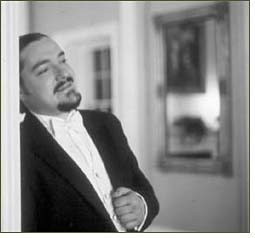
 Born in Venice, Italy, Roberto Poli has been portrayed on many occasions as a Renaissance man, enjoying an international career as a performer and being very much involved in writing, poetry and painting. Some ascribe this eclectic activity to the immense patrimony of inspiration derived from his native city. While he does not dismiss it as a possibility, he mainly credits the irreplaceable experiences lived during his childhood and adolescence – a period of his life spent in contact with extraordinary artists in various disciplines, and whose influence he deems as fundamental. Born in Venice, Italy, Roberto Poli has been portrayed on many occasions as a Renaissance man, enjoying an international career as a performer and being very much involved in writing, poetry and painting. Some ascribe this eclectic activity to the immense patrimony of inspiration derived from his native city. While he does not dismiss it as a possibility, he mainly credits the irreplaceable experiences lived during his childhood and adolescence – a period of his life spent in contact with extraordinary artists in various disciplines, and whose influence he deems as fundamental.
It was not until the age of twelve that Roberto Poli began to take piano lessons, after he convinced his parents to rent an upright piano. He was privileged to study for over ten years with Giorgio Vianello, a pupil of Busoni's disciple Gino Tagliapietra, graduating from the Venice Conservatory of Music Summa Cum Laude and Honors in 1993. His studies continued under Philippe Cassard, Roni Rogoff, Vladimir Tropp, Tatyana Zelickman, Piero Rattalino and Eugenio Bagnoli. Between 1994 and 1996, his main inspiration was his work with Boris Petrushansky at the Piano Academy Incontri col Maestro in Imola, Italy.
In May 1996, while performing in Japan, Roberto Poli received a phone call that changed his life: he was requested to return immediately to Italy to serve his country, and was stationed at a Bosnian refugee camp at the outskirts of Italy's border with Croatia, shortly after the war in Bosnia came to an end. It was a period of hardship in which his performing activity came to a nearly complete halt. This hiatus from the concert platform was nevertheless a crucial period of growth in which writing and poetry became an alternative vehicle of expression. It was during this time that his first essays on music and a series of poems depicting the life of the Bosnian refugees and the experiences lived during those months took shape.
As his duties came to an end, Roberto Poli moved to North America, invited by the Gina Bachauer Foundation to participate in their 1998 International Piano Competition. The success at the event prompted an unexpected outcome: on a very short notice, at the end of July of that year he was offered a full scholarship to attend the New England Conservatory of Music and follow the great artistry of legendary pianist Russell Sherman – an unprecedented situation at that institution. It was then that Roberto Poli moved to Boston and made the United States his home. Under Sherman's guidance, he received a Master's Degree and the prestigious Artist Diploma – a highly selective degree reserved only to a handful of candidates each year.
After Roberto Poli's American debut was saluted by the press as "pure magic", similar assessments have been expressed around the world in cities such as New York, Dublin, Rome, Boston, Tokyo, Brussels, Calgary, Paris, Seoul, and wherever he travels. Acclaimed as a soloist on both piano and harpsichord, and as a chamber musician and conductor, Roberto Poli has appeared with the Monet Ensemble, the Trio di Venezia, the Chameleon Arts Ensemble of Boston, soprano Elizabeth Keusch, clarinetist Jonathan Cohler, and cellists Sarah Carter and Ronald Lowry. In recent years, he has appeared in extensive and critically acclaimed tours of South Korea and the United States with cellist Daniel Lee.
Roberto Poli is considered by many an eloquent communicator and a rising exponent of the music of Fryderyk Chopin, which he has comprehensively studied through manuscripts and original editions and widely performed throughout the world. Begun as a celebration of Chopin's 200th birthday in 2010, during which time he was a featured lecturer, performer and master teacher at the Chopin Festival held at the University of Virginia, the center of Roberto Poli's current interest is the recording on video of the composer's complete works. The first DVD, titled Frederic Chopin: the late works, was released in 2008 on the Rebus label, and features a live performance of Opp. 58-62. A parallel project, begun in June 2009 and supported by the European label Onclassical, features his audio recordings of Chopin’s complete
works, now at its fifth volume. In 2011, the London-based label Piano Classics has signed a licensing agreement with Onclassical, and will be releasing Roberto Poli's complete Chopin recordings over the course of the next six years. The first volume has be released worldwide in June 2011. The second volume is scheduled to appear at the end of this year.
Roberto Poli's activity as a prolific writer began with the publication of his first critically acclaimed book, The Secret Life
of Musical Notation: defying interpretive
traditions (Amadeus Press, 2010). Based on years of research and performance, and presenting original groundbreaking insights, The Secret Life of Musical Notation features discoveries based on the analysis of Chopin's manuscripts and early editions, and provides a new vision of his works that is both scholarly and practical. Additionally, the book features the multi-media interaction of text and audio-clips, which illustrate each example in the author's interpretation. A second book is in the making, and discusses the concepts of time, rhythm and musicality through the eyes of both the musician and the modern man, and how we can relate to the past to find a musical language for the future.
Roberto Poli is the Artistic Director of The Chopin Symposium, a yearly event held at the Rivers
School Conservatory in Weston, Massachusetts, which gathers world-renowned performers, pedagogues and lecturers. Past guests were Bruce Brubaker, Edward Cohen, Jeffrey Kallberg, Elizabeth Keusch, Jim Samson, Russell Sherman and Alan Walker. At the 2010 Symposium, Roberto Poli reenacted Chopin's last concert in Paris, performing on an 1845 Pleyel piano on loan from the Frederick Collection; and at the 2011 symposium, he impersonated Sigismond Thalberg in a reenactment of the duel between Liszt and Thalberg at the palace of Cristina di Belgiojoso, which took place in 1837.
Roberto Poli's critically acclaimed debut recording, Shall we dance..., was released in 2002 by Americus Records, and features his transcription of Maurice Ravel's La Valse for solo piano, along with other unusual selections such as Sergio Fiorentino's transcription of Waltzes from Strauss's Der Rosenkavalier, and works by Elizabethan composers. A second album, released in 2008 by Onclassical, features Franz Liszt’s Années
de Pèlerinage - Deuxième
Année: Italie, which he recorded in 2002.
Roberto Poli is an enthusiastic sought-after teacher and lecturer. He holds positions at the Rivers School Conservatory in Weston, Massachusetts, where he is the Artist-in-Residence and co-chair of the Piano Department, and at the New England
Conservatory’s
Preparatory School, teaching a select group of talented pupils. He also enjoys a busy schedule of masterclasses and lectures around the world.
Roberto Poli lives in Boston, where he continues his work as a musician, writer and painter, in addition to the restoration of his 1850s Victorian house overlooking historic Chester Square.
|
Poli
is a natural-born performer.
His confidence at the
keyboard invites the
entire audience to gorge
on the musical feast
he serves...
(Salt Lake
Tribune) |
|
|